


There’s plenty of writing advice and suggestions that can be found pretty much anywhere. There are authors who can afford to have a strict writing routine (e.g. from 8 to 17hs) but the majority has a part- or full-time job, meaning that time needs to be found to actually write.
It can sometimes be challenging to get into the rhythm if you can only find a couple of hours (or less) per week, so a few encouraging phrases can help motivate you or keep you on track.
While I’ll be paraphrasing, here are a few well-known things to stay motivated.
First, one hundred words is better than none. Getting started and writing something is better than nothing, so cut yourself some slack if you don’t reach your goal. And in line with this, you can’t edit what you haven’t written. So, no matter how bad you might think the idea is, or how unsure you are about how it fits in the grand scheme of things, just write it. You can edit it later (or entirely delete it, if it really doesn’t fit).
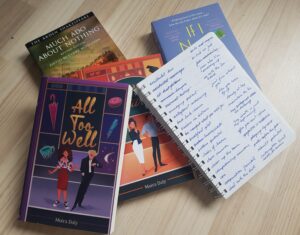
Of course, sometimes ideas can come at the worst of times, like when you’re dozing off. Or if you just wake up randomly and are sluggish. Many times I’ve told myself I’d remember the idea. Ha! Because of this, there’s a notebook on my bedside table that occasionally gets scribbles I can almost understand on the following morning.
When it comes to writing proper, the usual saying goes, write what you know. While this is a good idea (I don’t think I’d be able to properly depict what it’s like for an astronaut living on the Moon), I don’t take it as a limiting concept. Rather than interpreting it as “write only what you’ve experienced firsthand”, I think about it as “do your research”. You can learn what you’ll write about, even if you’re not getting firsthand experience. Just don’t half-ass the research if there’s a component of realism (such as in the setting).
I also keep close to me “write what you want to read”. Sometimes I get frustrated with things I read (maybe some romantic tropes I dislike), and that might trigger an idea that tackles a similar conflict in a way I’m much more interested in.
Of course, most important is that you find what works for you. What’s your most productive time of day? Do you prefer music or silence? Do you like writing by hand or on a computer? Do you plot everything out before you start, or do you let the story work itself out as you go?
Try out different aspects until you find those that help you stay focused and motivated.
And last but not least, “All the world’s a stage, and all the men and women merely players…”. No one can tell the same story you can, and everyone’s got something to show. Don’t be afraid, sit down (or stand up), and write!


